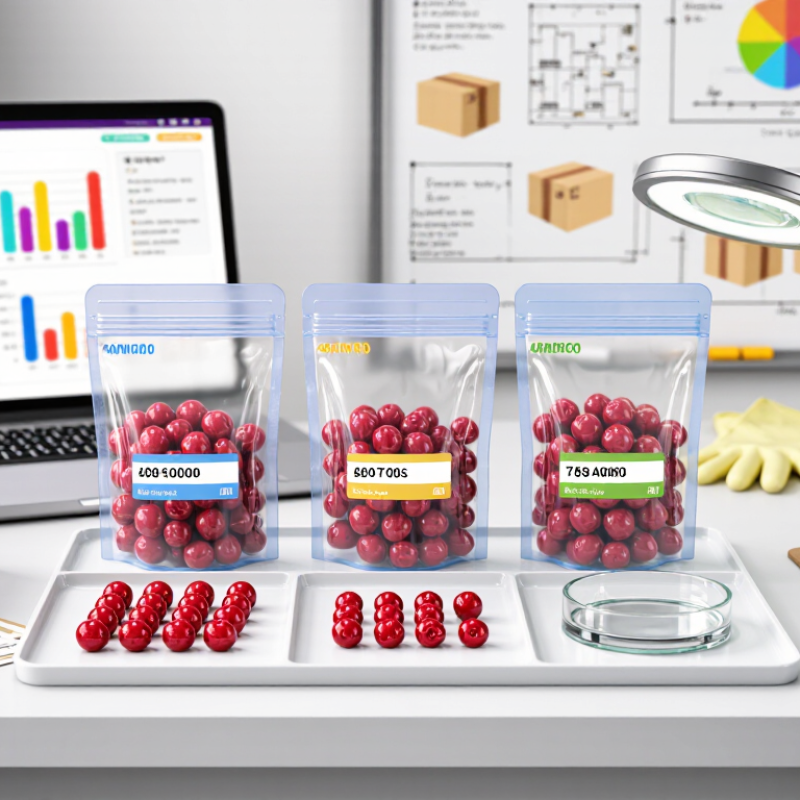
| 1. Product Definition | Product format | U100 dried cherries, 85g net weight per retail pouch | Net contents tolerance: verify the applicable legal market requirement; use calibrated checkweighing | Approve the written product specification before requesting a quotation |
| 1. Product Definition | U100 grade meaning | Define whether U100 refers to size, appearance, ingredient purity, or an internal grade code | Attach a measurable grade sheet with size range, defect limits, color, texture, and broken-fruit percentage | Do not rely on the term “U100” without a supplier-signed definition |
| 1. Product Definition | Ingredients | Confirm cherries, sweetener, oil, preservatives, and allergen statement separately | Require a current ingredient declaration and nutrition panel for the destination market | Match the approved formula to the final printed packaging |
| 2. Supplier Qualification | Food-safety documentation | Valid food-safety certification, traceability procedure, allergen controls, and recall procedure | Review documents before sample approval and again before shipment | Check certificate scope, validity dates, and manufacturing-site address |
| 2. Supplier Qualification | Pre-shipment testing | Microbiological, pesticide-residue, foreign-material, moisture, and water-activity testing as required by the market | Use an independent laboratory when the risk level or customer requirement justifies it | Release the shipment only after reviewing results against agreed limits |
| 3. Order Planning | Planned order quantity | 10,080 pouches at 85g each | Total finished product weight: 856.8kg, excluding packaging materials and pallets | Reconcile purchase quantity with forecast, launch date, and minimum shelf-life requirement |
| 3. Order Planning | Carton configuration | 24 pouches per export carton | 420 cartons; 2.04kg net product per carton before secondary packaging | Confirm carton dimensions, gross weight, pallet pattern, and carton-marking requirements |
| 3. Order Planning | Shelf life | Target 12 months from production, subject to formulation, packaging, and validated stability data | Set a receiving requirement of at least 9 months remaining shelf life | Print lot code, production date, best-before date, and storage instruction |
| 4. Purchase Order | Commercial terms | Specify currency, unit price, payment milestones, Incoterm 2020, destination, and quotation validity | Use a signed purchase order and pro forma invoice before production begins | Ensure the invoice, packing list, and purchase order show identical quantities and descriptions |
| 4. Purchase Order | Artwork and packaging | Food-contact pouch with approved barcode, nutrition information, allergen declaration, lot coding, and recycling marks where applicable | Approve digital proof and physical pre-production sample before mass printing | Verify barcode readability and mandatory labeling in the destination country |
| 5. Production Control | Indicative production lead time | 15–25 business days after artwork, deposit, and raw-material confirmation | Add 2–3 business days for final quality review and document preparation | Request weekly progress updates and production photographs where appropriate |
| 5. Production Control | Quality acceptance | Check net weight, seal integrity, appearance, odor, texture, label accuracy, carton count, and lot traceability | Document nonconformities with photographs and corrective-action deadlines | Use an agreed inspection plan rather than accepting goods by visual judgment alone |
| 6. Delivery Management | Transit planning | International ocean transit commonly requires approximately 25–35 days, excluding port congestion and customs delays | Airfreight is faster but normally has a higher transport cost; compare total landed cost | Book transport after cargo readiness and document accuracy are confirmed |
| 6. Delivery Management | Required shipping documents | Commercial invoice, packing list, transport document, certificate of origin where required, health or phytosanitary documents where applicable, and test reports | Send scanned documents before arrival to support customs pre-clearance | Check product description, tariff classification, origin, quantity, and gross weight for consistency |
| 6. Delivery Management | Storage and receiving | Keep sealed cartons in a clean, dry, pest-controlled area away from direct sunlight and strong odors | Record arrival date, lot number, carton count, damaged units, and remaining shelf life | Use FIFO or FEFO inventory rotation and quarantine damaged or undocumented cartons |
| 7. Final Reconciliation | Landed-cost review | Include product price, packaging, inspection, freight, insurance, duties, taxes, customs clearance, warehousing, and inland delivery | Calculate landed cost per 85g pouch and per export carton | Close the order only after quantity, quality, documents, and invoice totals are reconciled |