| 1 | Global Market Context | The global smart lock market generated approximately US$2.8 billion in revenue in 2023, according to the cited Grand View Research market context. | Prioritize suppliers with documented export experience and product lines designed for residential, rental, hospitality, or commercial applications. | Export records, product catalogues, regional certifications, and application references. |
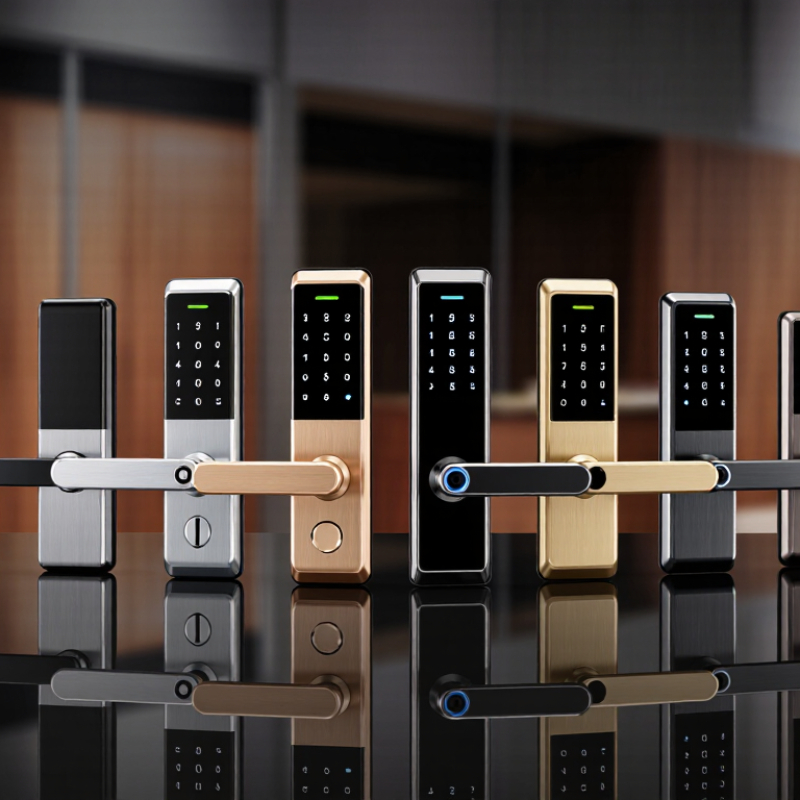
| 2 | Keyless Access Methods | Common access methods include PIN codes, RFID or NFC credentials, Bluetooth Low Energy, mobile applications, remote cloud access, and physical override keys. | The supplier should clearly define which access methods are included, optional, or dependent on a gateway or subscription. | Functional samples, access-control matrix, mobile application demonstration, and gateway requirements. |
| 3 | Mechanical Compatibility | Compatibility depends on door thickness, backset, mortise or cylindrical configuration, handing, latch dimensions, and cylinder requirements. | A complete dimensional drawing should be available before sampling or mass production. | 2D drawings, installation templates, door-thickness range, and a physical fit test on the target door. |
| 4 | Electrical Power Design | Battery-powered locks require defined battery type, low-battery warning, emergency power input, standby-current data, and a mechanical or electronic backup method. | Battery-life claims should be stated under a defined test profile rather than as an unqualified number. | Battery test report, current-consumption data, emergency-power test, and low-battery alert demonstration. |
| 5 | Wireless Connectivity | Bluetooth Low Energy is suitable for local mobile access; Wi-Fi enables direct network connectivity; a gateway may be required for remote access on some designs. | The product specification should identify radio bands, communication range, gateway dependency, and offline behavior. | Wireless specification sheet, range test, router compatibility list, and offline-access test. |
| 6 | Cybersecurity and Data Protection | Relevant controls include encrypted communication, secure credential storage, authenticated firmware updates, account management, event-log protection, and access revocation. | Suppliers should provide a documented security architecture and vulnerability-response process. | Security white paper, penetration-test summary, update policy, privacy policy, and incident-response procedure. |
| 7 | Environmental Protection | An IP rating describes protection against solid particles and water ingress; IP54, for example, indicates limited dust ingress protection and protection against water splashes. | The required rating should match indoor, sheltered outdoor, or exposed outdoor installation conditions. | IP test report, operating-temperature range, corrosion-resistance test, and outdoor installation validation. |
| 8 | Compliance and Safety Documentation | Export requirements may involve electromagnetic compatibility, radio-equipment, electrical-safety, chemical-substance, and market-specific conformity requirements. | Compliance must be assessed for the destination market and for the exact hardware, radio module, charger, and software configuration. | Declarations of conformity, laboratory reports, safety files, material declarations, and certification scope checks. |
| 9 | Software and Integration Capability | Integration may use mobile SDKs, cloud APIs, webhooks, property-management interfaces, or smart-home standards such as Matter where supported by the specific product. | The supplier should distinguish between local control, cloud control, third-party integration, and recurring service fees. | API documentation, sandbox access, integration test report, data-hosting details, and service-level terms. |
| 10 | Quality, Warranty, and After-Sales Support | Key quality indicators include incoming-material inspection, production traceability, functional testing, failure analysis, spare-parts availability, and warranty response procedures. | Use a documented quality plan with agreed acceptance criteria rather than relying only on a factory audit or product sample. | Quality-management certificate, inspection plan, sample approval record, warranty terms, spare-parts list, and response-time commitment. |