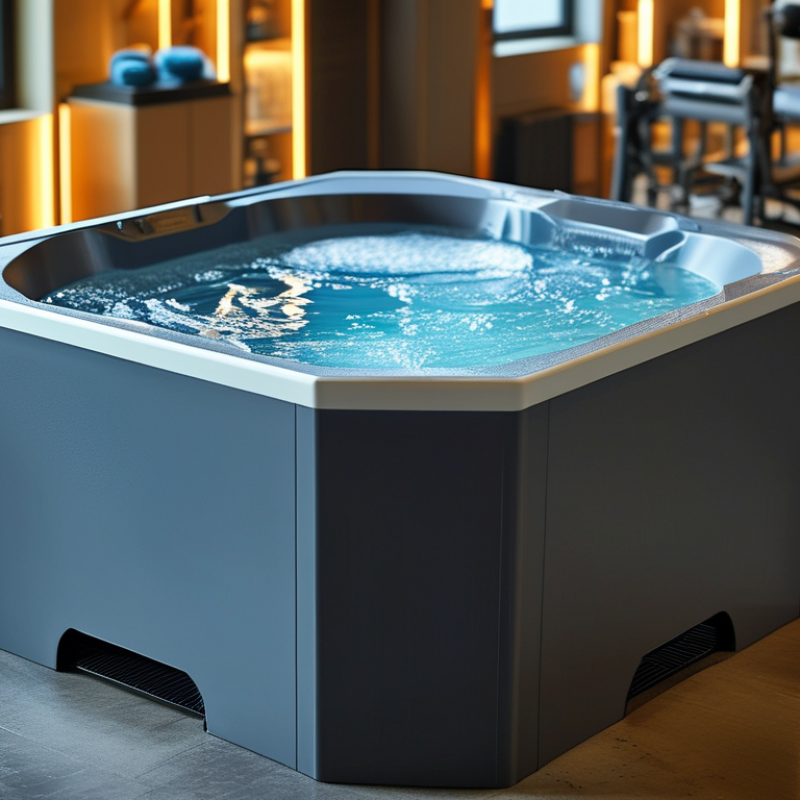
| Product Definition | A cold plunge cooling unit is a refrigeration system designed to remove heat from plunge-bath water and maintain a selected low temperature. | Commonly configured for residential, commercial, wellness, and athletic-recovery applications. | Clarifies whether the equipment is a dedicated water chiller rather than a general-purpose air-conditioning or refrigeration product. |
| Cooling Method | Most units use a vapor-compression refrigeration cycle with a compressor, condenser, expansion device, and water-side heat exchanger. | Air-cooled systems are common; water-cooled versions may be used where heat rejection and ventilation require special handling. | The cooling method affects installation requirements, noise, heat discharge, maintenance, and operating cost. |
| Recommended Water Volume | The water volume that the unit can cool effectively under specified ambient, starting-water, and insulation conditions. | Approximately 300–1,500 L for many compact and mid-size systems; larger commercial systems may support more. | A mismatch between tank volume and chiller capacity can result in slow pull-down, excessive runtime, or unstable temperature control. |
| Temperature Setpoint | The target water temperature selected through a controller, thermostat, or digital interface. | Many cold-plunge applications operate around 3–15 °C, depending on user preference and operating conditions. | The supplier should state the minimum achievable temperature and the conditions used to verify it. |
| Cooling Capacity | The rate at which the unit removes heat from the water, normally expressed in watts, kilowatts, BTU/h, or horsepower-equivalent marketing ratings. | Compact systems are often rated from about 0.5–2.0 kW of cooling capacity; actual output varies with test conditions. | Cooling capacity should be compared using the same inlet-water temperature, ambient temperature, and flow conditions. |
| Pull-Down Time | The time required to reduce the water from an initial temperature to a specified target temperature. | Often several hours for a full tank; time depends on water volume, insulation, starting temperature, and cooling capacity. | A credible supplier should provide test data rather than a pull-down time without operating conditions. |
| Water Flow Rate | The volume of water circulated through the filtration and heat-exchange loop per unit of time. | Common compact-system pump ratings are approximately 20–60 L/min, subject to head pressure and plumbing configuration. | Adequate flow supports heat transfer and filtration, while excessive flow may increase noise and energy use. |
| Water-Side Heat Exchanger | The component that transfers heat from the circulating plunge water to the refrigerant circuit without mixing the two fluids. | Titanium heat exchangers are widely selected for water-treatment compatibility and corrosion resistance. | Material selection is important when using salt, disinfectants, ozone, or other water-treatment methods. |
| Filtration and Sanitation | Filtration removes suspended particles; sanitation systems help control microorganisms in the recirculating water. | Systems may include a replaceable cartridge filter, UV treatment, ozone, chemical dosing, or a combination. | Cooling performance and water hygiene are separate functions, so both should be evaluated before purchase. |
| Energy Consumption | Electrical power consumed by the compressor, fan, pump, controls, and optional sanitation components during operation. | Many small systems use roughly 0.5–2.5 kW while actively cooling, depending on capacity and ambient conditions. | Ask for input power, rated current, duty-cycle assumptions, and standby consumption instead of relying only on cooling-capacity claims. |
| Noise Level | The sound pressure produced by the compressor, condenser fan, water pump, and cabinet vibration. | Approximately 45–65 dB(A) is a common stated range for compact air-cooled equipment, measured conditions permitting. | Noise measurements are meaningful only when the distance, room conditions, and operating mode are disclosed. |
| Electrical Supply | The voltage, frequency, phase, plug type, circuit protection, and maximum current required for safe operation. | Common configurations include 220–240 V at 50/60 Hz; regional versions may require different electrical specifications. | Electrical compatibility must be confirmed before ordering to avoid unsafe operation or costly modifications. |
| Refrigerant Information | The refrigerant type, charge quantity, safety classification, and applicable environmental requirements. | Refrigerant selection varies by model and market; documentation should identify the exact refrigerant and compliance status. | This affects serviceability, import requirements, technician qualifications, and long-term regulatory compliance. |
| Operating Environment | The permissible ambient-temperature, humidity, ventilation, and installation conditions. | Many air-cooled units are designed for indoor or sheltered outdoor use, but the specified ambient range must be checked. | High ambient temperature, inadequate ventilation, and direct weather exposure can reduce capacity and shorten service life. |
| Cabinet Protection | The enclosure’s resistance to dust, water ingress, corrosion, and accidental contact with electrical parts. | Protection ratings differ by design and market; an IP rating should be verified from technical documentation. | The enclosure must match the installation location, especially in wet, humid, coastal, or commercial environments. |
| Supplier Verification | Review technical datasheets, sample testing, quality-control records, warranty terms, spare-parts availability, and after-sales support. | A qualified supplier should provide consistent specifications, traceable testing information, and clear installation documentation. | Independent verification helps distinguish tested cooling performance from incomplete, inconsistent, or non-comparable claims. |