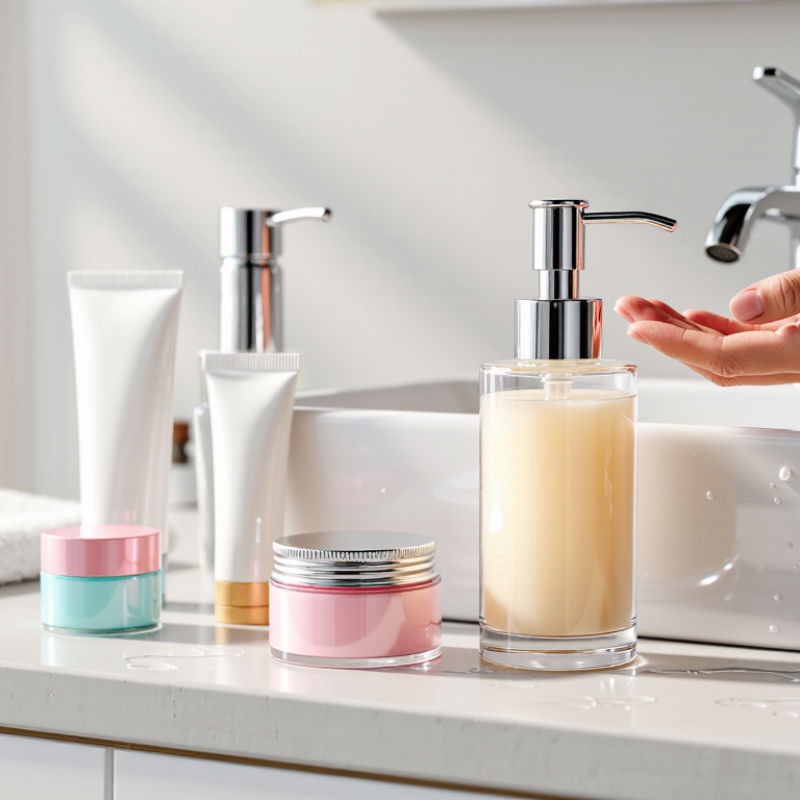
| What a skincare pump is | A dispensing closure fitted to a container. Pressing its actuator moves product through an internal passage and out of the nozzle. | Provides a controlled way to dispense liquid, lotion, gel, or other compatible formulas. | Pump performance depends on the formula’s viscosity, container, and pump design. |
| Basic pump mechanism | On a typical pump, pressing the actuator drives a piston and dispenses product. Releasing it allows the mechanism to reset and draw more product into the pump chamber. | Repeated presses dispense successive portions without needing to pour product from the container. | Many pumps need to be primed with several presses before product first appears. |
| Measured dispensing | Each full press is designed to release a dose determined by the pump’s chamber and mechanism. | Can make application more consistent and help limit over-dispensing. | Output per press varies by pump model, formula, and how fully the actuator is pressed; it is not automatically an exact dose. |
| Lotion pump | A dip tube typically carries product from the container to the pump chamber, where pressing the actuator dispenses it through the nozzle. | Commonly suited to pumpable products such as lotions, liquid cleansers, and some gels. | Very thick, particulate, or otherwise incompatible formulas may dispense poorly or clog the pump. |
| Airless pump | Many airless packages use a moving piston or flexible inner pouch to push product toward the dispensing opening as product is used. | Can reduce the amount of air that enters the product package during use and may help dispense product from the container more fully. | “Airless” does not mean that a package contains no air at all or that a formula is completely protected from oxidation or contamination. |
| Hygiene and handling | The product is dispensed through an outlet rather than being scooped out by hand. | Reduces direct contact with the remaining product compared with repeatedly dipping fingers into an open jar. | The nozzle can still collect residue, and the package should be kept clean and used as directed. |
| Formula compatibility | The pump’s spring, seals, dip tube or inner system, and outlet are in contact with or exposed to the formula. | A compatible package supports dependable dispensing during normal use. | Compatibility should be evaluated with the actual formula, including its viscosity and ingredients, through package testing. |
| Product protection | A closed pump package limits routine exposure of the product to the open environment compared with an open container. | May be useful for products where limiting repeated exposure or direct handling is a packaging priority. | Packaging alone does not replace appropriate formulation, preservation, storage, or product testing. |
| Best-fit products | Selection is based on how the formula flows through the pump and how the product is intended to be applied. | Pumps can work well for many cleansers, moisturizers, serums, and other pumpable skincare products. | Confirm the pump’s output, dispensing consistency, and user experience with the finished product before choosing packaging. |